By Samantha Drumm
Hometown Weekly Staff
Those looking for a slow stroll, a long hike, or an at-home adventure won’t be disappointed by the over 700 acres Adams Farm offers for exploration.
The large property, purchased by the town in 1997, loosely includes private conservation trusts adjacent to the 300 acres of town-owned land, as well as the adjacent property owned by the New England Forestry Foundation and the Norfolk County
Agricultural School.
Prior to being sold to the town, much of Adams Farm’s Land was owned by Walpole’s Isaacs family.
The Isaacs family were long-time Walpole residents. Mr. Isaacs, an early conservationist, acquired property in Walpole and other locations in eastern Massachusetts over the years. His purchases, in addition to his North Street home, included about 400 acres across and down North Street, including Hillcrest Farm. Hillcrest Farm was the original farmhouse and barns for the current Adams Farm property. He placed most of this property under a protective tax, both agricultural and forestry-related, to keep the property in its pristine condition for the future.
Upon his death, his son Kenneth C.A. Isaacs assumed control as administrator of his father’s estate. Facing estate taxation issues as administrator, much like family farms everywhere, he was forced to offer the property for development in order to meet estate tax obligations. However, with the tax protection mode selected by the senior Isaacs, the Town of Walpole had the right of first refusal.
Based on the recommendation of the Selectmen of Walpole, as proposed by the Isaacs Land Study Committee, an $8 million override ballot question was proposed to maintain the land. This override was passed by the people of Walpole, speaking volumes to the intent of the people of Walpole to preserve this land for the future.
The initial purchase cost to the Town was $7,715,000. Had the Farm not been purchased, 170 (or more) houses would have been built on the land, depriving the community of the outdoor sanctuary that is Adams Farm.
My favorite way to spend an afternoon at Adams Farm is walking a quick lap through the Butterfly Garden with an ice cream cone from Buubling Brook, just down the street.
At one point, there were 14 monarch butterflies on one bush, and more on other adjacent bushes.
Adams Farm’s reservation area helps the monarch butterflies and all pollinators with milkweed plants and nectar plants in the monarch waystation field, the butterfly garden, and the community garden.
Created in 2008, the Butterfly Garden has become a destination for visitors to Adams Farm. Once the warm weather arrives, no matter when you visit, you’re sure to be enchanted by the display. From snowdrops in the early spring to sedum in the fall, there’s always something in bloom.
The following year, in 2009, the Community Garden opened at Adams Farm. All 32 plots were rented by local gardeners eager to plant their first crops. Since then, the Garden has doubled in size to 64 plots, and the gardeners’ enthusiasm has only increased, as evidenced by their flourishing plots of vegetables, fruits, and flowers.
For a modest rental fee, gardeners can rent a 20×20-foot plot in the Community Garden, which is surrounded by a perimeter fence to keep animals out. The rental fee includes access to water and compost for mulching. Gardeners may rent a full plot or split a plot with a friend. In the spirit of nature conservation, only organic gardening is permitted; no pesticides, weed killers, or chemical fertilizers may be used. What’s more, the Community Garden boasts a bee yard, complete with two beehives.
The importance of community is complete with gardeners organizing an annual Winter Seed Swap to exchange flower, vegetable, and herb seeds.
Gardeners work individually and in small teams to perform various maintenance tasks in the garden, such as watering, composting, aisle weeding, and hose and cart repair. The gardeners also organize several potluck suppers during the summer for friends and family.
The Garden and all it produces are a great benefit to all the gardeners, but the friendships, the sense of community, and the peace so many find when they are working in the Community Garden are what make it such a special place.
“I've had such a great time at Adams Farm. I love coming out there at about 6:30 am and watching the wind whip through the grass as I park the car and the sun rises,” says one member of the Community Garden. “Working the soil in the morning or whacking the weeds on Friday morning are my 'outside times'. . . . You should have seen me yell at the first strawberry sighting!”
The approximately 365 acres of Adams Farm and 300 acres of additional abutting open space provide a superb refuge for regional flora and fauna, along with space for seasonal visitors.
An abundance of feathered creatures frequent the Farm. Special accommodations have been provided for resident bluebirds in the form of wooden birdhouses by Friends of Adams Farm member Bob Hennessey.
As spring approaches, there is no better time to visit Adams Farm to look at and listen to the many different birds that arrive to either raise families or rest up as they migrate further north.
Mid-May is the height of the breeding season at the Farm, and you don’t have to go very far to see some of the farm’s star performers. Stepping out of your vehicle in the parking lot on a sunny morning, you’ll be met with all white and black birds fluttering over the fields singing a bubbling metallic song, and you have found the resident Bobolink. This bird builds a nest suspended in the tall grass deep in the fields.
The many birds either sitting on the wire fence or flying over the fields like little jet fighters with metallic blue backs and white bellies are Tree Swallows. They catch insects in the air and raise their young in the nest boxes along the fence.
There is also a very good chance of seeing one of the conservation team’s favorite stars, the Eastern Bluebird. This bird bears a bright sky blue coat and a reddish-orange patch on its white breast. He sings a short but cheery song.
All these birds and many more, like bright orange and black Baltimore Orioles, Eastern Meadowlarks, Red-winged Blackbirds, Grey Catbirds, Barn Swallows, and Yellow Warblers, can be seen by taking only a few steps from your vehicle early on a spring morning.
By walking a short distance up the main trail to the back field, where the trees line the trail and you just begin to enter the woods, you may catch a glimpse of a fiery red bird with black wings high in the tree tops singing a loud robin-like song, the Scarlet Tanager. Another beautiful singer you may find hidden in the tops of the trees is the Rose-Breasted Grosbeak. His song is the richest of the robin-like songs; almost as if a robin were granted singing lessons.
There are many more birds to see throughout the various habitats on the Farm, from the familiar backyard birds like the Chickadee, Cardinal, and Titmouse to the most diverse and varied group of all, the Wood Warblers. Enough to entertain any beginner or to challenge the most knowledgeable bird expert.
Unfortunately, many of our flying friends face a declining population and habitat erasure. The Sisyphean demand for developments and housing is what makes sanctuaries like Adam’s Farm so essential for our local songbirds.
If you’re still searching for adventure after some birding, you can walk on in the woods to discover the labyrinth at Adams Farm. The labyrinth is a wonderful way to stay safe while getting lost while taking a walk in the woods.
This labyrinth is a meditative tool used for contemplative walking that consists of a long path that continuously doubles back on itself, bordered by stones, low hedges, or walls. The labyrinth at Adams Farm is located near #106 on the Blue Trail, about 10 minutes from the parking lot. Look for the labyrinth signs on the trees, follow the path into the woods, and you’ll soon see the labyrinth tucked into a clearing on the right.
Jessica Lastarza, a Friends of Adams Farm board member, conceived the labyrinth with the idea of offering a unique space for meditation. Jessica invited Sandy Cardinal, a labyrinth designer from Western MA, to visit Adams Farm to create an inconspicuous labyrinth made of natural materials that would blend in with the setting and be easy to maintain.
The paths of the labyrinth begin to take shape.
Working with the exact dimensions of the space, Sandy designed a 5-circuit labyrinth that fit the site perfectly. Volunteers returned to the site later to rake the paths of the labyrinth and line the walls with small rocks. Hikers and adventurers are invited to explore the meandering labyrinth and take a moment to relax, and even add their own rock to its winding walls.
Most hikers choose the Blue Trail loop, which makes a circuit from the parking lot down the Blue Trail through the woods to the back meadow. Crossing the meadow, the Blue Trail returns to the parking lot through the woods on the other side of the meadow, with several boardwalks adding to the adventure. It's a 2-mile easy walk that can take about an hour to hike.
For a shorter hike, visitors can walk on the Dave Lehto Trail around the perimeter of the front field, where volleyball courts are located for added fun, or take the Monarch Trail in the field behind the barn that curves around to meet the main trail for an easy walk back to the parking lot.
Those who prefer a longer hike can head out across the power lines via the Red Trail and explore the more challenging hilly terrain at the back of the property. You can easily hike 4 to 6 miles at Adams Farm following trails that crisscross the woods, meandering past vernal pools filled with noisy wood frogs and spring peepers, and giving you the chance to hear a variety of bird calls.
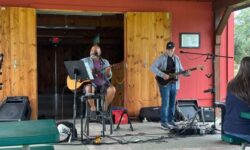
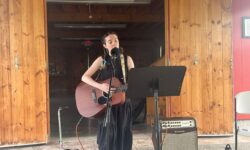
Adams Farm is a reservation for wildlife and outdoorsy adventurers alike. Ot offers endless community initiatives and local events, readers are encouraged to check out their website - www.adams-farm.com - for a trail map of the property, descriptions of hikes of various lengths, and a long list of outdoor events including live music, open mics, and nature walks.
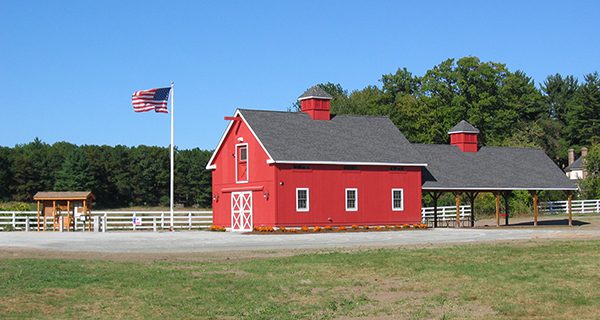
Trail maps are also available in the kiosk next to the barn, and maps of several longer hikes at Adams Farm can be downloaded from the AllTrails app for those who have it.
Thank you to the Friends of Adams Farm for your help and all you do for the community. If you have ideas for new walking paths for the Hometown Weekly to explore, please send them over to samantha@hometownweekly.net
Tags: walking, where to walk, outdoors, Adams Farm