




By Isabell Macrina
Hometown Weekly Staff
You are probably familiar with the playground rhyme “Lizzie Borden took an ax/And gave her mother forty whacks, /And when she saw what she had done, /She gave her father forty-one” about the double murder that happened in Fall River, Massachusetts in 1892. The story of Lizzie Borden has inspired many creative works, operas, ballets, a series of novels just to name a few. Most recently it inspired the latest season of the Netflix anthology seires “Monsters: the Lizzie Borden Story.”
But it wasn’t really forty whacks, and it wasn’t really Lizzie Borden’s mother. Former justice Dennis J. Curran of the Massachusetts Superior Court joined the people at the Medfield Council on Aging to break down the myths of the Lizzie Borden trial and shed some light on the legal proceedings and what happened thereafter.
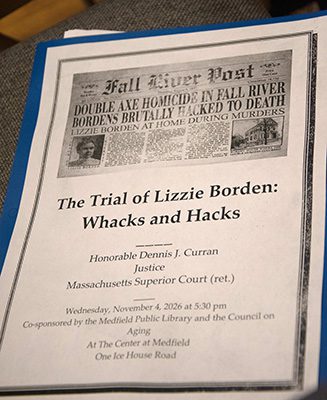
On that August day in 1892, Lizzie Borden was 32, unmarried, and at their family home in Fall River with her father, Andrew, her stepmother, Abby, and their maid Bridget Sullivan. Her older sister Emma was out of town. By morning, Andrew and Abby were found dead on the floor with 10 wounds and 19 wounds from a hatchet, respectively. Lizzie was the prime suspect, having been the subject of her father’s frugality with money and refusal to move from the business district to their “Hill” house with much more prestige, even after helping Abby’s family financially. Lizzie longed to climb the ladder socially, but her father refused to spend money to fund a more lavish lifestyle.
Justice Curran focused on the legal controversies present in the trial. The case had three judged presiding over it; Chief Justice Albert Mason, Judge Blodgett, and Judge Justin Dewey. At the last minute, former MA Governor was Robinson was added to Borden’s defense team, which created a conflict of interest as he had appointed Judge Dewey to the lifetime judicial bench.
The prosecution was led by District Attorney Hosea Knowlton, who took over after Attorney General Arthur Pillsbury declined due to pressure from women’s’ groups and political groups. A private letter was found later, revealed Knowlton had serious doubts about prosecuting and wanted to throw the case away entirely.
Between the lack of confidence in the prosecution and the conflict of interest with the judge and defense, it is not a surprise that Borden was found not guilty by the jury. She went on to life her life as a social outcast, eventually dying of pneumonia at age 66.
We may never know the true tragedy of the Borden family, but thanks to Curran we now have more information that went into the trial proceedings. He also provided a folder of research and more readings that can be done on the case for people interested. The Lizzie Borden case remains one of the more intriguing crimes committed in the state of Massachusetts, and will continue to be prevalent in pop culture for a long time.

