By Samantha Drumm
Hometown Weekly Staff
 “You should see the Charles River, it has dwindled almost to a brook—and has lost all its Boston character,” wrote artist Dennis Bunker to the collector and philanthropist Isabella Stewart Gardner.
Gardner’s namesake, the iconic Isabella Stewart Gardner Museum, is just one of Boston’s essential art galleries that houses Bunker’s paintings of Medfield.
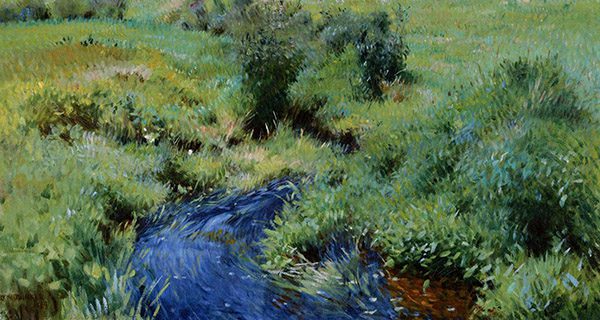
Bunker spent the summer of 1889 admiring Medfield’s natural beauty before passing at 29 in 1890. In the penultimate year of his life, he painted this landscape, titled “The Brook at Medfield.” Gardner purchased this, one of the only Impressionist works in her extensive collection, the following November.
The previous year, Bunker and his friend, painter John Singer Sargent, experimented with Impressionism in the English countryside, both taking inspiration from Claude Monet. When Bunker returned to Boston, he continued practicing the style, drafting brilliantly rendered landscapes with modern techniques to capture the effects of sunlight.
Although none of Bunker’s English paintings are known to survive, his Medfield landscapes are characterized by his command of Impressionist technique, applying vivid colors in long, flowing, visible brushstrokes that perfectly capture the waving grasses, bubbling stream, hazy light, and humid air.
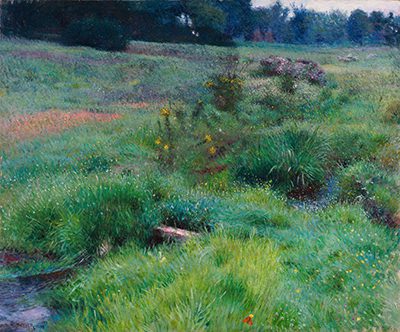
The Gardner Museum is not the only esteemed Boston staple to boast an impressionist rendition of Medfield in its collection–the Museum of Fine Arts displays Bunker’s The Pool, Medfield, in its Art of the Americas wing.
The contentment of the lazy, dragging eternal summer afternoon is palpable from the painting.
Bunker spoke of this tranquility in a letter to Gardner, writing:
It runs here through the most lovely meadows, very properly framed in pine forests and low familiar-looking hills—all very much the reverse of striking or wonderful or marvelous, but very quietly winning and all wearing so very well that I wonder what more one needs in any country… The calmness of everything here—its roughness and simplicity is to me most charming and restful.
Bunker’s renderings, featured in the respective museums, depict a perfect New England summer day—the gurgling brook and birdsong are almost audible as one admires the artwork.
Bunker’s slices of summer slowly seep into fall, with pieces like “Roadside Cottage” and “Interior of a Barn: Medfield.”
Like Monet’s chronicling of his haystacks through the tumult of the seasons, Bunker was inspired to document the same landscape over the course of the summer. He wrote to Isabella, “How fast the Summer is slipping by us! Everything goes at such a pace—there is even a hint of autumn stealing into my parti-colored canvases, tho' I try to keep them in their Summer garb….”
18 months after painting “The Pool, Medfield,” Bunker passed. But he left behind a number of renditions of our hometown that have made their way across the country–his portrait of his wife, “Elanor Miller Bunker,” sits on display at the Metropolitan Museum of Art in New York. Roadside Cottage, another musing on Medfield’s quiet beauty, made its way to the National Gallery of Art in Washington, D.C.
For locals, any location is redolent of one of Bunker’s pieces. Meadow Lands blends with the Wheelock Fields, "Interior of a Barn,” just might be the grist mill, “The Pool” resembles the churning Charles as you pull to the side of the road on Causeway.
Bunker’s pieces are a testament to our hometown’s natural beauty and to how it has withstood the passage of time and modernization since the summer he captured these historic illustrations 137 years ago.