By Isabell Macrina
Hometown Weekly Staff
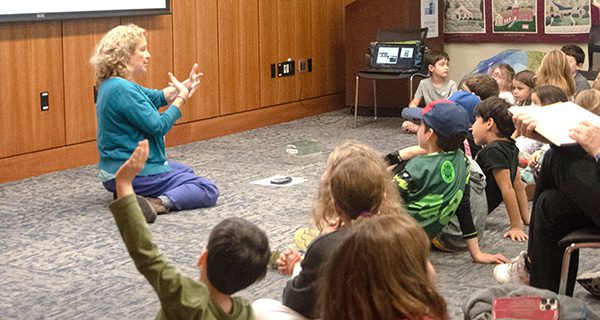
The owls of New England are brilliant creatures that fly silently and can spin their heads nearly all the way around, but how do they get enough nutrients at night to keep active. Miss Heather led an activity for kids explaining all about at owl’s diet, how they digest their prey, and how they get rid of the bones that wouldn’t process through.
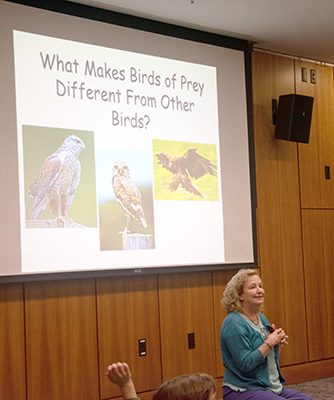
Heather sat the children at the front of the room to start by talking about owls themselves. New England is home to a few different kinds of owls, the biggest one in the region is the great horned owl, which ironically with its name, doesn’t have horns. Instead it has tufts of feathers on top of its head that mimic horns. There’s also the barn owl, with white and tan feathers and a heart shaped face, and the barred owl with stripes on its plumage. There are also smaller owls, like the eastern screech owl which is about the size of a robin, and the northern saw-whet owl which is only about 7 inches long.
While it would be hard to see the owls in person, given they are nocturnal and camouflage themselves in the trees, its not uncommon for you to hear them. Heather played recordings of each owl songs and the kids sang them back the best they could.
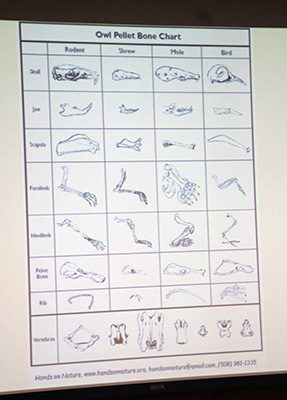
Owls have a unique biology, they have round eyes bigger than their brains so they must rotate their heads to see instead of turning their eyes like we can, and their ears are beneath their feathers so the sound goes around them and lets them find their prey even in a busy forest. That prey consists of small rodents and even lizards and snakes, which they swallow whole. Heather shows the skeletons of the creatures they eat and the different bones they may find when they dissect their own pellets!
The kids broke off into teams of three, each assigned one sanitized pellet and long sticks to dissect it, and papers to fill in what they find to see what the owl ate. Dissecting owl pellets is a way scientists determine how the ecosystem is doing, seeing how much and what they eat to figure out how a particular area is doing. The kids got to be their own scientists, breaking up the pellets in trays and sorting the bones by animal and what they look like. Some even built part of a shrew skeleton. It is important to get kids interested in the world around them and the science that goes into conservation and animal protection. Small experiments like this are a fun and engaging way to get the kids started.