By Isabell Macrina
Hometown Weekly Staff
Symphony music can be a gorgeous experience filled with instruments in harmony, but it can be overwhelming for people who are unfamiliar in that space.
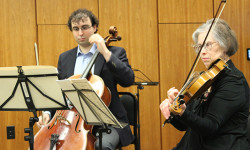
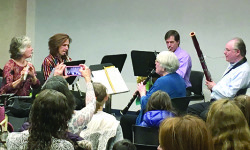
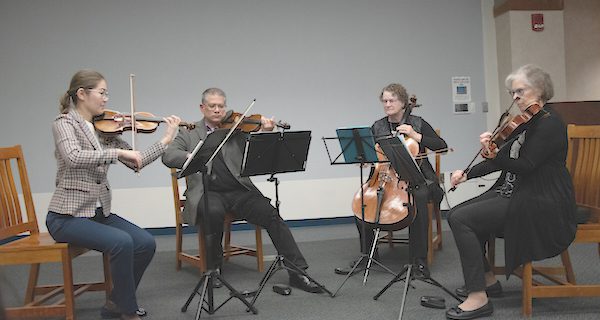
Wellesley Symphony Orchestra hopes to change that, so their String Quartet came to Wellesley Free Library to present a fun, informal, and family friendly program that serves as an introduction to symphony and classical music.

Their program today consisted of four pieces, each composed of a distinct set of movements, it is like a series as they are works of music designed to work together. Before each piece, one of the musicians stood up and taught the group a little about each instrument.
First was, appropriately, first violinist Ainur Tulendiyeva. Tulendiyeva spoke about the violin, how they can be played with long bow draws or short ones to create different sounds depending on the piece. Something that intrigued the kids in the crowd, and some adults too, is that the strings of a violin bow are made from horsehair. She explained that the first violin section in an orchestra plays the melody and in a quartet like this one, the higher notes as well. They showed this off by starting with Mozart’s Allegro, a brighter collection of movements that seemed to chase winter blues away.

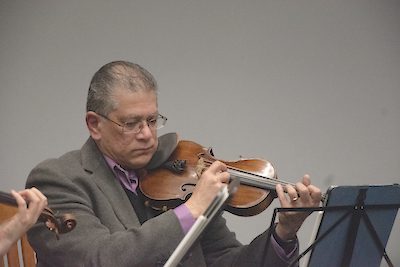
Second was, again fittingly, second violinist Cecil Pereira. If you’ve heard the term “playing second fiddle,” that is quite literally his job. They help make up the body of the song behind the melody. But Pereira brings up another thing stringed instruments can do, pizzicato. Italian for “picked” or “plucked,” rather than drawing their bow across the strings they use their fingers and pluck the strings to make the notes. The whole quartet played a piece that required all of them to pluck their instruments, as if the notes were jumping into our ears.
The biggest of all the instruments in the quartet was up next, Jan Schwarner on the cello. She, along with Pereira, made up the rhythm section. She is the fundamental sound coming from the quartet, playing the bass notes to build up a strong foundation.
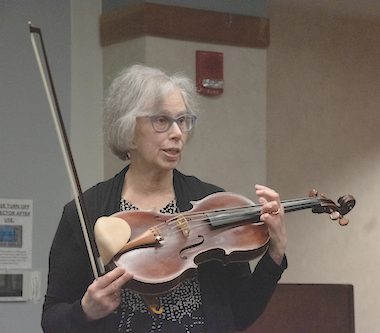
And last, but certainly not least, was Carol Davidson on the viola. While it looks like a slightly oversized violin, the viola is the most different of all the quartet instruments. Their sizes aren’t standard, unlike the violin which are all a set size, and the viola is tuned to ADGC on the string, while the others are AEDG. It is also an octave higher! The notes from the viola are usually mellower and quieter, residing inside the music instead of higher or lower.
After an informational performance, the group asked if there was a birthday in the crowd and there was! A local gentleman in attendance had his birthday that day, so they finished the program off with a rendition of “Happy Birthday” and a few other birthday classic songs.
 It was amazing how many different notes come from four instruments, and this program gave so many patrons an insight to the world of symphony music.