By Meghan Foley
Hometown Weekly Staff
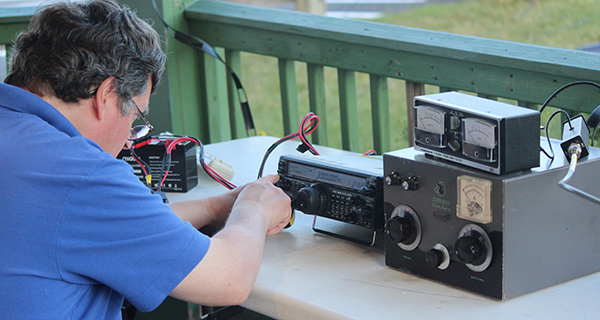
Over the weekend, Wellesley Amateur Radio Society (WARS) gathered in Needham’s Memorial Park Gazebo to participate in the American Radio Relay League’s Field Day. Dan Brown of WARS’ Board of Directors explained the purpose of Field Day: “This exercise is an effort to provide emergency radio communications for potential natural and man-made disasters when cellular, Internet and power infrastructures are down, as well as demonstrate radio to the public.”
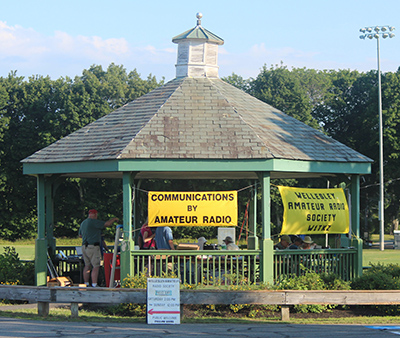
“[Many might think,] ‘I have a cell phone, what do I need this for? I can just call anyone in the world, right?’” Explained Tom, a member of the group for many years. “And in fact you can, but you need [your cellphone provider] to have their cell site near you work. They need to have their connection between those cell towers to their switching station. And their switching station—all the switching stations across the country to wherever you’re calling … and that all needs to be working for that call to work. And it’s very reliable. Except when it isn’t. So, what we do—we’re talking directly to those people. We don’t need any infrastructure. So, we’re going right from these antennas.
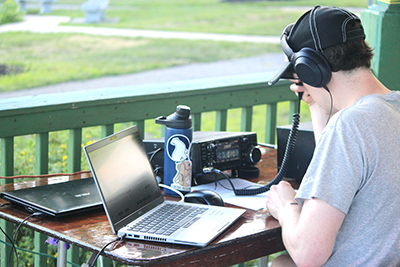
All [of these] radios [are] using solar power,” he continued. “So, there’s no—so, this is a real emergency operation, we set up the antennas this morning. …Ultimately, it’s all emergency power-based. All the radios—there’s no infrastructure reliability here. We’re talking directly to a person in Southern New Jersey using—from that antenna to their antenna. … That’s the advantage, for why this is used—this is an emergency drill.”
Another member, Stu Solomon, spoke about his interest in emergency communications and the importance of volunteers even outside of the group, working with SkyWarn, a National Weather Service Program:
“I’m a Regional Coordinator for the SkyWarn program, which basically means anytime there’s big, severe weather … we run what’s called ‘nets’ on the radio and take reports … what’s going on on the ground. Because the Weather Service can’t see that. Their radar points up. They don’t necessarily know anything about what’s happening on the ground, so we feed them all that information kind of as it’s happening. So, I’ll run these nets every hour or so and people call in with local conditions, any flooded roads, any down trees, any of that sort of stuff, so a lot of situational awareness.
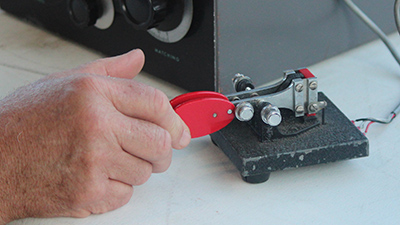
Another angle is [emergency services], where just if there’s any kind of disaster situation and extra communication is needed, we can, you know, work with [emergency service groups such as FEMA or the local police], so that’s a big component of it.
Field Day kind of speaks to that, we get out in the field, use battery power—no commercial power—or antennas, and basically practice for what may happen, what we hope never happens.”
Beyond necessity, another goal is to reach as many people as you can. Throughout Field Day, participants log the location of every person they make contact with. Some of their radios were set to frequencies aimed more locally, reaching fellow New Englanders, while others made contact across the country.
“So the cool thing about it is people ask me, ‘Where can you talk to?’ Anywhere on the planet,” answered Tom. “You have to pick the right time of day and the right frequency. And that’s just, that’s something you learn—to get the license, you have to pass an exam.
For a lot of us, the interesting thing is—it’s like a skill. You learn a skill and say ‘Geez, you know, how many countries can I talk to? How many states can I talk to? How many continents can I talk to? … How many counties?’ (of the over 3,000 in the United States).
So, there’s all kinds of things you can do that peak your interest, for some people it’s technological. I’m an engineer by training, so, technological—’can I build a station at Field Day?’ … For me, that’s the thing. Less—for me, I’ve done it for so long, it’s less the operating, more ‘can I build the stations’—for me.”
“In another sense,” said Solomon, “it’s like a social event, where people get together and learn, they learn how to use their radios better, they get tips from other people, swap stories.”
WARS was one of thousands across North America to participate in this annual event this past weekend.
Wellesley Amateur Radio Society is celebrating its 75th anniversary this year. To learn more about the group, you can visit their website at: wellesleyradio.org