



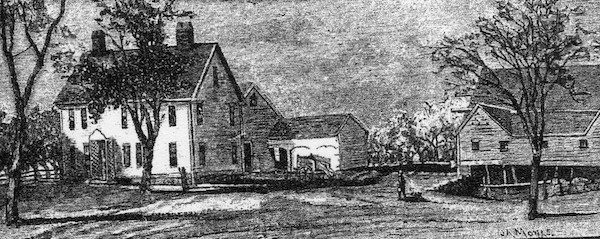
The Underground Railroad is one of the most enduring and popular threads in the fabric of America’s national historical memory and it is a part of the local heritage here in Medfield. Historically, what we today call the Underground Railroad was the process by which slaves escaped northward from the South to the free states and then after the passage of the Fugitive Slave Law in 1850, northward all the way to Canada for freedom. The Underground Railroad was made up of individuals and the collective actions of thousands of slaves who were trying to achieve liberty and a new beginning to their lives. These attempts to go North to freedom put pressure on slavery itself, caused significant political tensions between the North and the South and started a small but important group of abolitionists who resisted the Fugitive Slave Law and aided the fugitive slave to freedom. A member of this important abolitionist group was Ellis Allen of 260 North Street, Medfield.
Ellis Allen born in 1792, was the third of eight children born to Phineas and Ruth Smith. The Allens were strong churchgoing members of the Unitarian Church. Phineas was a deacon in the church and two of his brothers, Asa and Joseph, were Unitarian clergymen. Growing up in the Allen household with such strong liberal Unitarian beliefs, discussions must have had a major impact on the progressive moral beliefs of Ellis. His father also brought strong patriotic values to the dinner table, having served throughout the American Revolutionary War as Minuteman and then soldier in the Continental Army.
At the age of 22 Ellis married Lucy Lane of Scituate. During their marriage they would have eight children: William, George, Joseph, Lucy, Nathaniel, Fanny, Abby and James.
Ellis became very involved in the abolitionist movement, which brought him into Boston to hear lectures by William Lloyd Garrison, founder of the Massachusetts Anti-slavery Society and editor of the abolitionist newspaper, The Liberator. He would make a friendship with Garrison that would last for the rest of his life. Ellis invited Garrison out to 260 North Street and began holding anti-slavery meetings there. Among the many speakers was Frederick Douglass, the former slave, anti-slavery orator and author of the Autobiography of Frederick Douglass.
Said Garrison of Allen, “I shall always hold him in remembrance as one of the tried and true of the Old Guard of Freedom.”
The 260 North Street house became a frequent meeting place for abolitionists and a safe stop on the Underground Railroad. All this activity was not always greeted with respect by others in Medfield. Ellis Allen had Garrison’s newspaper, The Liberator, delivered by mail to Medfield’s Post Office. So unpopular was the paper here that the postmaster refused to handle it and would only give it to Ellis by holding it at length with fire tongs.
Allen housed, clothed and fed fugitive slaves on their way to Canada, even though, if caught, there was a $100 fine for doing so. If there was an anti-slavery meeting scheduled to be held and no minister would announce it from the pulpit, Allen would rise and read the announcement.
Ellis’ son, Nathaniel, followed closely in his father’s footsteps and was also active in the Abolitionist Movement. It was reported that he would drop whatever he was doing to take a slave from 260 North Street on to the next stop on the slave’s route to Canada. Nathaniel opened the West Newton English and Classical School with 35 students. While Nathaniel Allen was a white educator, he was deeply committed to integration, enrolling black, Spanish and Japanese students into his classes. Allen sought to engage his students in the controversial political and social issues of the times. He had distinguished lecturers such as William Lloyd Garrison and Ralph Waldo Emerson discuss the “sins of slavery.” He became president of the West Newton Anti-Slavery Society and was an officer in the Society of Garrison Abolitionists. The Allen School was often used as a meeting place for anti-slavery meetings.
Ellis Allen stands today as a major figure in the abolitionist movement, whose name deserves to be alongside Garrison and Douglass in the history books and 260 North Street stands as a historical landmark on the Underground Railroad. The story of the Allens gives our school system an excellent opportunity to learn about the Abolitionist Movement through the actions of a local Medfield family whose actions impacted the lives of thousands and had a major impact on the history of our country.

